For company directors Pay into your pension through your company.
Specialist support for sole directors of limited companies.
Excellent from 13 Google reviews
Why directors should look at their pension
Why director-only companies should consider a workplace pension
- Self-employed people and sole company directors are known to be at risk of not saving enough for retirement.
- The State Pension alone falls short of a comfortable retirement.
- Regular pension contributions through your company can unlock tax benefits.
Expert help choosing and setting up a scheme
- All the major providers
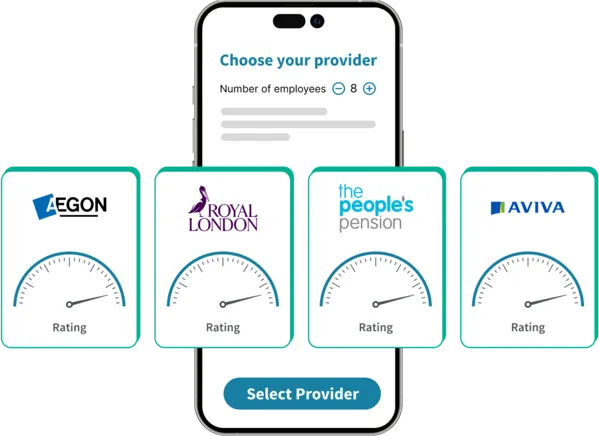
- Compare schemes from all the major pension providers.
- See every fee
- Full transparency over fees and investment strategies.
- Choose by your values
- Rank schemes on their ethical and green credentials.
In a director’s words
“We tried to “go it alone” with our AE and soon got bogged down in the process. Husky and the team of dedicated experts managed to unravel the mess we had inadvertently created and put us on the path to compliance with their expert knowledge of the legislation.”
Husky in numbers
- 2,000+
- Businesses have saved money, streamlined admin and ensured compliance with Husky.
- 10,000+
- Individuals have more control over retirement planning because their employers use Husky.
- up to80%
- Saved on pension fees with Husky’s exclusive preferential rates.
- £50,000+
- In fines avoided, after we resolved compliance issues for our clients.
Questions directors ask
More answers are in the knowledge base.
Can a company director be exempt?
Some workers who would normally meet the Auto-Enrolment (AE) criteria may be exempt or excluded from AE if they are Directors of a company.
A director is only a worker for AE purposes if:
- they have a contract of employment with the organisation
- at least one other person (who can be another director) also has a contract of employment with the organisation
Therefore, if a director has a contract of employment and is not the only person working for the company under an employment contract, they have AE duties.
Depending on their age and earnings, the Directors may qualify for AE. However, even if the Director qualifies, the company keeps the right to choose whether to enrol the Director into the scheme or not. The director would retain the right to opt into the scheme.
See more details here.
If you have a worker that shouldn't be enrolled on a scheme due to being a Director, please enter that into Husky's system so that no contributions are made.
How does tax relief work on a workplace pension?
When employees contribute to their pension scheme, they get tax relief on their contributions. This means that some of the employee’s pay, which would otherwise have gone to the government as tax, instead goes into their pension pot.
Tax relief on pension contributions may be given in two ways: “Net Pay” or “Relief at Source”:
Net Pay Scheme - Contributions are deducted from the employee’s gross salary (i.e. before tax has been deducted). This means that the employee automatically receives tax relief at his or her highest rate of income tax.
Relief at Source Scheme - Contributions are deducted from the employee’s net salary (i.e. after tax has been deducted). However, the employer deducts only 80% of the total contribution from the employee’s salary; the scheme then adds the basic rate tax relief amount (20%), which is claimed from HMRC by the pension provider.
Additional things to Note:
A pension scheme can only use one method for all members and this affects lower or higher paid staff in different ways:
- Employees who don't pay income tax only get the government top-up in relief at source schemes. If the scheme was on net pay, these employees won’t get tax relief and will have to pay 20% more for their pension.
- Higher and additional rate taxpayers only get their full tax relief “up front” in a net pay scheme. If the scheme is a relief at source scheme, these members get only basic rate tax relief up front and need to reclaim the balance of their full tax relief (40% for higher rate taxpayers and 45% for additional rate taxpayers) by completing a self-assessment tax return (or writing to HMRC).
You can find more information tax relief like how it impact non-eligible employees, making claims for higher rate tax payers, and the aceess to its details within our Husky App here
What are the minimum pension contributions?
From 6 April 2019 onwards, the minimum workplace pension contributions is a total of 8%, at least 3% of which must be paid by the employer.
These minimums are required by the auto-enrolment legislation. The employee must contribute 5% but they may reduce their contribution if the employer decides to contribute more than the minimum.
What earnings are pension contributions based on?
The earnings basis refers to the basis of the employee’s earnings that are used for calculating pension contributions. See the options below:
- Qualifying Earnings:
- Total Minimum required: 8% of all Banded Earnings
- Company Minimum: 3% of all Banded Earnings
- Definition: All earnings between £520pm and £4,189 per month are the banded range
- All earnings include any of the following components: salary, commission, bonuses, overtime, maternity pay, statutory sick pay, etc.
- Pensionable Pay Set 1
- Total Minimum required: 9% of all Basic Earnings
- Company Minimum: 4% of all Basic Earnings
- Definition: Basic Salary used to calculate contributions. Excludes any additional earnings (i.e. bonuses, overtime, etc.)
- Pensionable Pay Set 2
- Total Minimum required: 8% of all Pensionable Earnings
- Company Minimum: 3% of all Pensionable Earnings
- Definition: Pensionable Earnings must be at least equal to basic pay and at least 85% of the total earnings (All earnings include bonuses, commission, overtime, etc.)
- Pensionable Pay Set 3
- Total Minimum required: 7% of all Pensionable Earnings
- Company Minimum: 3% of all Pensionable Earnings
- Definition: Pensionable pay includes all earnings (All earnings include basic salary, bonuses, commission, overtime, etc.)
What are qualifying earnings?
Qualifying earnings is the name given to a band of earnings used to calculate contributions for Auto-Enrolment:
- Total Minimum required: 8% of all Banded Earnings
- Company Minimum: 3% of all Banded Earnings
- Definition: All earnings between £520pm and £4,189 per month are the banded range
- All earnings include any of the following components: salary, commission, bonuses, overtime, maternity pay, statutory sick pay, etc.